
Blood Bowl Sevens Combined
BLOOD BOWL SEVENS
Welcome to Blood Bowl Sevens, the fast and furious game of fantasy football. Blood Bowl is, by its very nature, a game that can take a couple of hours or more to play. For many coaches, real-world commitments, such as work and family, can mean that finding
time for a full-length game can be difficult, and taking part in a league almost impossible. Blood Bowl Sevens addresses this by allowing coaches to play with smaller teams and reducing the number of turns, creating a version of the game that can be
played in under an hour.
What's more, this simplified version of the game is ideal for younger players, many of whom wish to play and want to learn the rules, but often find the complexity of Blood Bowl daunting. Blood Bowl Sevens, with its simplified format and smaller teams, allows
younger coaches to master the game without being overwhelmed by the rules.
THE BLOOD BOWL SEVENS PITCH
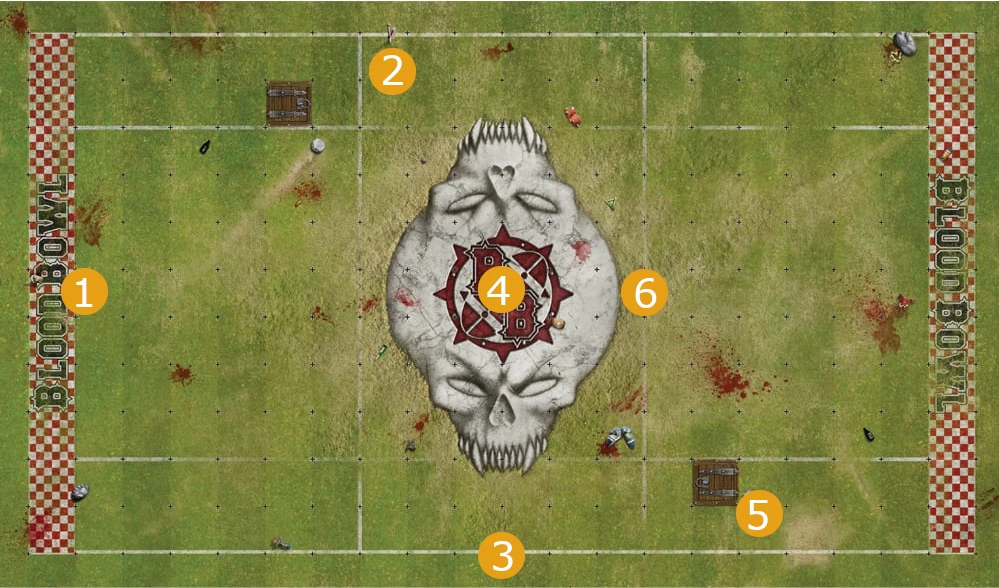
A Blood Bowl Sevens pitch shares many similarities with a standard Blood Bowl pitch, but there are a few key differences to be aware of. A Blood Bowl Sevens pitch features:
- Two End Zones, one at each short end of the pitch.
- Two Wide Zones, one at each side of the pitch, running from End Zone to End Zone.
- Two Sidelines, running the length of the pitch, from one End Zone to the other.
- The Centre Field, the area between each Wide Zone, running, the length of the of pitch from End Zone to End Zone.
- There are two trapdoors on the pitch, one each half, both positioned within a Wide Zone.
- The pitch is then further split along its length into three thirds by two Lines of Scrimmage each marking the point at which one of the teams will line up for the kick-off!
Finally, the board itself is split into a grid of squares; seven squares from each Line of Scrimmage to each End Zone and six squares between each Line of Scrimmage, making the pitch 20 squares long in total, and 11 squares wide; two squares in each Wide Zone, seven squares across the Centre Field.
DUGOUTS
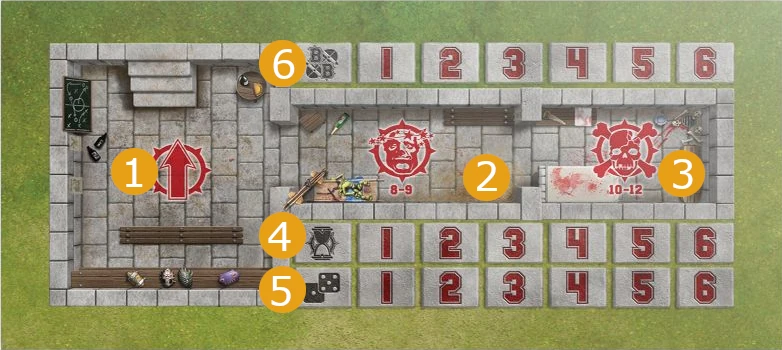
As with normal Blood Bowl, each team in a Blood Bowl Sevens game has its own dugout, a safe haven at pitch side where reserves can warm up, where the injured can be tended to and where important game information is tracked. The dugouts used for Blood Bowl Sevens are almost identical to normal dugouts, as described in the Blood Bowl rulebook, except for one important difference; on a Blood Bowl Sevens dugout, the turn and team re-roll trackers only go up to six, rather than the usual eight. This is because there are only six turs per half in a Blood Bowl Sevens game.
- The Reserves box.
- The Knocked-out box.
- The Casualty box.
- Turn trackers
- Team re-roll trackers.
- The Score tracker.
DRAFTING A BLOOD BOWL SEVENS TEAM
Blood Bowl Sevens teams are drafted just like other Blood Bowl teams, using the same team rosters. However, there are a few key differences to be aware of:
TEAM DRAFT BUDGET
The Team Draft Budget is the amount of gold pieces you have to spend on your rookie team:
When drafting a Blood Bowl Sevens team for league play, you have a budget of 600,000 gold pieces to spend on players, Sideline Staff, team re-rolls and so forth.
HIRING PLAYERS
Players are the only compulsory element on any Blood Bowl Sevens team. Each team roster details all of the players available to a team of that type and their Hiring Fee. When drafting a team for Blood Bowl Sevens, you should select the players you want to permanently hire for your team, pay their hiring cost from your Team Draft Budget and make a record of the player on the Team Draft list.
NUMBER OF PLAYERS
The first and most important thing to be aware of when drafting a Blood Bowl team is the minimum and maximum number of players permitted:
- Every Blood Bowl Sevens team must contain a minimum of seven (7) permanently hired players when it is first drafted.
- No Blood Bowl Sevens team can ever contain more than eleven (11) permanently hired players.
JOURNEYMEN: As with any Blood Bowl team, during the course of a league season, the number of players a team can field may fall below seven due to injury and death. This is permitted and Blood Bowl Sevens teams may 'Recruit Journeymen' just like any other team. However, the quality of Journeymen available is likely to be lower than usual (such reserves are normally found in the local pub, after all):
- A Journeyman on a Blood Bowl Sevens team replaces the Loner (4+) trait with the Loner (5+) trait.
DESIGNER'S NOTE: CURRENCY CONVERSION
One important thing to remember about Blood Bowl Sevens is that it represents an amateur game, Neither the staff nor the players are professionals, and the sums of money thrown around aren't likely to be all that high!
With that in mind, we would suggest that, wherever possible, coaches use the term 'copper pieces' instead of 'gold pieces'. This has little to no bearing upon the game; a Human Lineman costs 50,000 'points', and how those points are named matters little, But for the purposes of Blood Bowl Sevens, referring to those points as 'copper pieces' rather than 'gold pieces' is far more characterful and, we have found, adds greatly to the fun!
PLAYER POSITIONS
There are distinctions to be made between the players within a team, separating them by their role within the game, from the humble Lineman to the more specialised roles performed by the 'positional' players.
LINEMEN: The backbone of any team:
- All teams will have a player type that they are permitted to take 0-12 or 0-16 of. Regardless of name (for many races call their Linemen by another name), this Player type is the team's 'Lineman' positional.
OTHER POSITIONS AND BIG GUYS: Unlike a normal team, a team drafted for Blood Bowl Sevens cannot simply recruit as many players of other types as the coach wishes. Blood Bowl Sevens teams represent amateur sides, so specialist players, such as Blitzers, Throwers and so forth, are quite uncommon:
- A Blood Bowl Sevens team may include a maximum of four (4) players that are not Linemen.
- A Blood Bowl Sevens team may not include more players of a certain type than are allowed by the team roster, For example, an Elven Union team is allowed 0-2 Blitzers, meaning a Blood Bowls Sevens Elven Union team may include zero, one or two Blitzers, but may not include three.